Family silence and secrets
I Know This Much Is TrueFamily silence and secrets are not simply omissions in the Birdsey family: they organize what can be asked, what can be recorded, and what remains unknowable. The subjects guarded most closely include the twins’ biological father and Ma’s cleft lip. Their histories also reach beyond the household, into Domenico Onofrio Tempesta’s manuscript and the clinical conversations about Thomas. Across these different kinds of evidence, private experience is repeatedly approached, partially disclosed, and left incomplete.
Forbidden subjects and visible difference
Dominick recalls that, among all the family’s forbidden topics, the identity of his and Thomas’s biological father and their mother’s disfigurement were the two most strictly avoided. That pairing links a hidden fact about the twins’ origins with a feature of Ma’s body that was visible to others but difficult for her to speak about. The silence does not make the subjects equivalent; it shows how the family’s rules could encompass both what was concealed and what was exposed to public judgment.
Ma had learned to cover her cleft lip with her right fist, a gesture she repeated throughout her life. Dominick understands it as a habitual apology for a birth difference over which she had no control. The gesture makes the burden of silence physical: rather than requiring an explanation, it shields the feature and anticipates the response of others. The narrative presents this as Ma’s practiced way of moving through the world, not as proof that the difference itself needed correction.
She also tells Dominick about being mocked as a schoolgirl. A boy named Harold Kettlety began taunting her, and other boys eventually joined in, chasing and ridiculing her at recess. Ma describes herself as fearful and as someone who had not provoked them. The account gives a history to the protective gesture: her concealment is connected to other people’s cruelty, not to any fault of her own. Her willingness to tell Dominick about this experience also marks a breach in the family’s customary avoidance of the subject.
A family history that resists completion
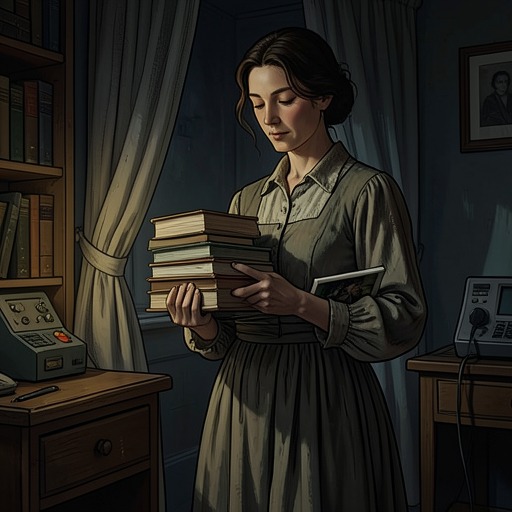
The family’s secrecy extends to the history of Domenico Onofrio Tempesta, Ma’s father. Dominick finds a thick manuscript in a large manila envelope, wrapped around a small, coverless dictionary and held with an elastic band. Its opening pages are typed, with originals and carbon copies; the rest is handwritten in blue fountain-pen ink. The mixture of forms makes the manuscript a tangible record, but its existence does not mean that the family already possesses a clear account of its past.
Ma recalls that her father was private. When she asked about his parents or the village where he grew up, he said he did not remember, or invoked a Sicilian rule of keeping one’s eyes open and one’s mouth shut. She had also heard him speak aloud as if arguing with himself. His manuscript thus sits in tension with his usual reticence: he had written a history despite rarely discussing his past directly with her. Ma says he had devised a complicated system, but the surviving account here does not explain its workings, so the system remains another part of the history that cannot simply be recovered from the manuscript’s presence.
On the morning he suffered a stroke, Domenico told Ma that he was nearly finished. She remembers being surprised to receive a progress report after he had previously said nothing directly about the work. When she asked what he planned to do with it, he considered destroying it rather than sending it to publishers in Italy, as he had once said he might. The manuscript therefore carries an unresolved choice: it records an effort to tell a life story, while its author contemplated making that story disappear.
Death and the unanswered question
Ma dies on May 1, 1987, after losing consciousness. Dominick and Ray keep watch through the night as she breathes with difficulty and repeatedly tries to remove her oxygen mask. A hospice worker suggests that they might give her permission to let go. Ray cannot bring himself to do so; when he is away, Dominick tells Ma he loves her, promises to take care of Thomas, and gives her permission to go. The promise turns a family obligation into a final spoken commitment at the moment when ordinary conversation is no longer possible.
Ma never reads her father’s history. Nor does she wake to identify the man who fathered the twins. After her death, Dominick recalls having considered a range of possible fathers, including Angelo Nardi, the courtroom stenographer hired to transcribe Domenico’s life story. He treats Angelo as a theory, not a disclosed answer, and tells himself that the identity does not matter. The distinction is important: the family’s central secret remains unresolved, and speculation cannot substitute for Ma’s testimony.
Silence, care, and clinical knowledge
The pattern of withheld or incomplete knowledge also appears in the twins’ treatment. A recorded session is dated October 23, 1990, placing private therapeutic speech into a record that can later be heard and interpreted. In another conversation, Dominick acknowledges that Dr. Willis Ehlers should have recognized a problem, but also accepts that he himself and others missed it. His response makes the failure collective rather than assigning responsibility to one person alone.
Dominick insists that Thomas feels safe and comfortable with a clinician, and resists the preferences of people elsewhere who might direct his care. The episode presents care as a question of trust as well as oversight: information about Thomas’s condition does not by itself settle who should guide his treatment. Dr. Patel explains that she wants to map Thomas’s past and present realities and asks Dominick to help her understand his brother. She describes Dominick as Thomas’s mirror and healthy counterpart, even a control group for the shaping of therapy. Her request makes the family bond a possible source of knowledge, while leaving Dominick’s participation conditional on his willingness.
Medical possibilities are raised without being turned into decisions. Dominick asks about Clozapine and another proposed option; Dr. Patel says she is not recommending that they pursue it immediately and presents the discussion as reassurance about a possible future. The exchange shows clinical speech bringing difficult possibilities into view, but not resolving them. As with the manuscript and the unanswered question of parentage, an explanation may be approached without becoming a final disclosure.
The work and limits of telling
Family silence and secrets recur across bodily experience, ancestry, mourning, and care, but the narrative does not treat every silence as identical. Ma’s fist responds to public mockery; Domenico’s privacy leaves his descendants with an incomplete written history; Ma’s death closes off an answer about the twins’ father; and the therapeutic scenes negotiate what Dominick can contribute to understanding Thomas. In each case, something becomes legible—a gesture, a document, a recorded session—without yielding complete access to another person’s life.
That structure gives the family archive its particular significance. The typed and handwritten pages, the remembered conversations, and the dated therapy recording preserve fragments, yet each depends on a person’s account and leaves gaps. The result is not a solved genealogy or a complete explanation of Thomas, but a continuing effort to distinguish what the family knows from what it suspects, remembers, or has been unable to ask. Silence protects some boundaries; it also passes uncertainty on to the people who remain.